
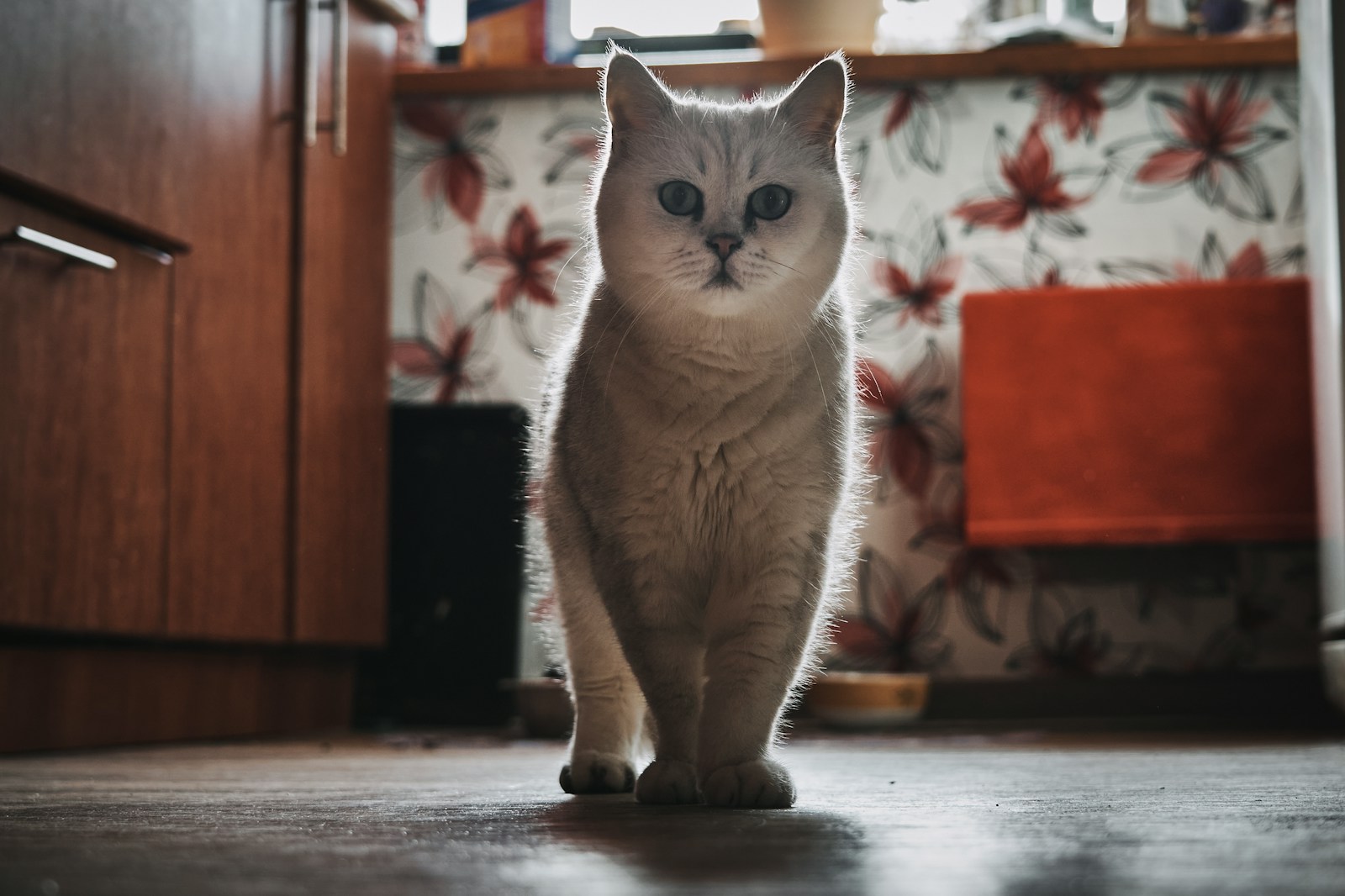
It’s one of nature’s most graceful mysteries: no matter how they fall, cats almost always manage to land on their feet. This uncanny ability has fascinated pet owners and scientists alike for centuries, and the explanation lies in physics, biology, and a touch of evolutionary genius.
Known as the cat righting reflex, this phenomenon demonstrates a cat’s innate balance and motor skills. Long before gymnasts or skydivers learned to twist midair, cats had already perfected the art of controlled falling.
The Science of the Righting Reflex
A cat’s righting reflex begins to develop when it’s just a few weeks old and is fully formed by seven weeks of age. When a cat falls, its body automatically performs a sequence of precise movements to reorient itself.
The process starts with the head. The cat first rotates its skull to face downward, then its spine follows in a coordinated motion. Its flexible backbone allows the front half and rear half of the body to twist independently, and it’s something humans can’t do.
Because cats have no collarbone and extremely mobile joints, they can adjust their limbs midair for balance. Their tails act as stabilizers, counter-rotating to fine-tune alignment. By the time they hit the ground, all four paws are ideally positioned to absorb impact.
In short: cats exploit physics like tiny, furry acrobats.
Angular Momentum and the “Twist Without Torque” Trick
One of the biggest mysteries for physicists was how cats could turn midair without breaking the laws of motion. Typically, rotating an object requires an external force or torque. But in 1894, French scientist Étienne-Jules Marey captured high-speed photographs of falling cats and proved otherwise—cats twist internally.
They redistribute angular momentum within their bodies. When the front half of the cat twists in one direction, the back half twists the opposite way, conserving total momentum. By alternating these rotations, the cat can spin itself upright without violating Newton’s laws.
It’s a biological form of controlled rotation. An internal dance of physics that even NASA later studied to understand spacecraft orientation.
Built for the Fall: Anatomy Meets Evolution
Beyond flexibility, cats are structurally designed to survive drops. Their low body mass and high surface area slow descent, functioning like a natural parachute. When combined with their bent limbs and relaxed muscles, impact forces are spread evenly, reducing injury.
In fact, studies in veterinary journals show that cats often fare better when falling from greater heights (over seven stories) than from moderate ones. At higher altitudes, they reach terminal velocity sooner and can fully extend their limbs to maximize air resistance. This counterintuitive “parachute effect” increases their odds of walking away with minimal harm.
It’s evolution’s way of turning peril into poise.
Lessons from the Feline Physics Lab
The cat’s righting reflex has inspired engineering and robotics research. Scientists study feline motion to design self-righting drones, space probes, and robots capable of correcting orientation during free fall. The principle also applies to astronaut training: how to reorient the body in zero gravity using internal momentum.
Even in art and philosophy, the cat’s fall has become a symbol of resilience and adaptability. But it’s also a reminder that flexibility, not force, enables survival.
So the next time your cat takes an unexpected tumble and lands with effortless composure, remember: it’s not magic. It’s physics in motion, perfected by millions of years of evolution.